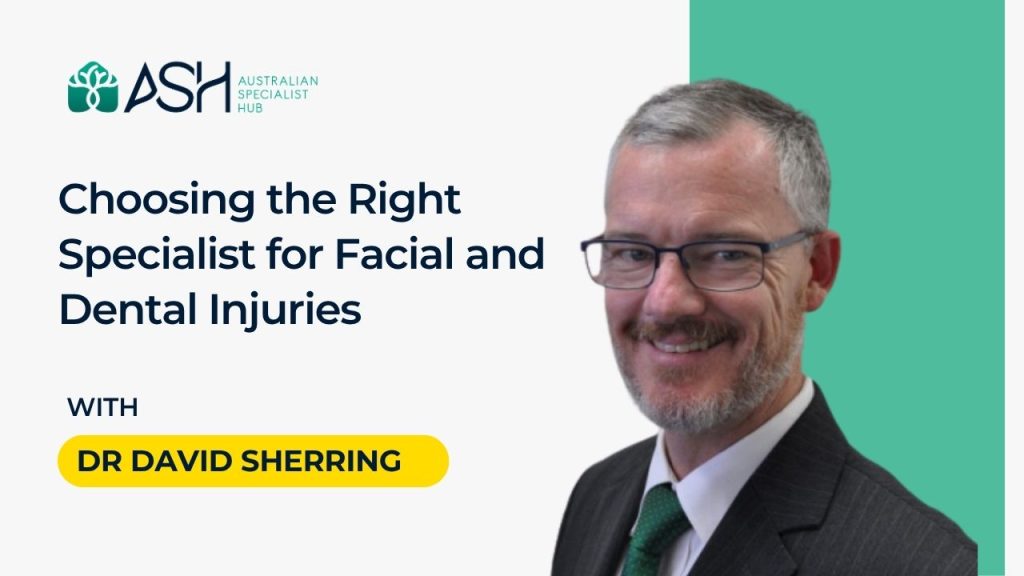
Get to Know Dr David Sherring: Choosing the Right Specialist for Facial and Dental Injuries
When a medico-legal matter involves the face, jaw or teeth, identifying the right specialist is not always straightforward. A matter that appears to be dental may involve facial trauma, skeletal structures, the temporomandibular joint or broader medical and psychological considerations.
For lawyers and case managers, understanding where maxillofacial surgery fits within this picture can help ensure the right expertise is engaged from the outset.
In the latest episode of The Consult, Australian Specialist Hub’s podcast, Dr David Sherring discusses the distinctive role of maxillofacial surgery and the challenges of assessing complex facial and dental matters in the medico-legal setting.
Where medicine and dentistry meet
Maxillofacial surgery occupies a distinctive position between medicine and dentistry. Maxillofacial surgeons undertake both dental and medical training before completing extensive specialist surgical training, giving them expertise across the structures of the face, jaws and oral cavity.
This dual background is particularly relevant in matters involving facial trauma and jaw disorders, where dental function and the underlying facial skeleton cannot always be considered separately.
Yet maxillofacial surgery remains a relatively small specialty, and its role is not always well understood outside the profession. This can create uncertainty when determining whether a matter should be referred to a dentist, another dental specialist, a maxillofacial surgeon or a different medical specialty.
The answer depends on the question that needs to be addressed.
The importance of staying within the right area of expertise
One of the key themes from Dr Sherring’s discussion is the importance of ensuring that an expert’s opinion remains within their area of expertise.
A maxillofacial surgeon may be well placed to assess facial trauma, temporomandibular joint disorders, jaw-related conditions and certain reconstructive or surgical issues. However, where a matter concerns a highly specialised dental issue, such as endodontic or prosthodontic treatment, the appropriate expert may be a specialist in that field.
The same principle applies where psychological factors are relevant. A reported association between a psychological condition and a jaw disorder does not, by itself, establish causation. Different components of the question may require input from different experts.
For lawyers, this distinction is important when formulating instructions and determining whether one expert can appropriately address all of the issues in dispute.
The right question leads to a better assessment
The referral process can have a significant impact on the usefulness of an expert assessment.
Dr Sherring highlights the importance of clear letters of instruction. When instructions are unclear or extend beyond an expert’s specialty, the expert may be left trying to determine what the legal team actually needs answered. Clear questions allow the assessment and report to remain focused on the relevant issues.
The supporting documentation is equally important.
In matters involving temporomandibular disorders, for example, historical dental records may contain information about previous grinding, clenching or other symptoms that an examinee does not recall during an assessment. Earlier records can therefore help an expert consider whether a condition is new, pre-existing or an exacerbation of an existing problem.
Similarly, where psychological factors are raised, references to a possible diagnosis should be distinguished from an established diagnosis supported by appropriate expert evidence.
Understanding the boundaries of expert evidence
Medico-legal questions often seek a clear answer: did one event cause a particular condition?
Clinical evidence, however, does not always fit neatly into a yes-or-no conclusion. In some circumstances, the literature may demonstrate an association or increased likelihood without establishing a definitive causal relationship.
For an expert, communicating that distinction is part of providing an appropriately evidence-based opinion. For legal practitioners, understanding the limits of what the evidence can establish can help frame more precise questions and avoid asking an expert to provide certainty where the available evidence does not support it.
Ultimately, specialist selection should begin with the issue requiring an opinion rather than simply the body part involved. A matter involving the face, jaw or teeth may require expertise from one specialty or several, depending on the questions in dispute.
Getting that referral right, providing a clear letter of instruction and ensuring the relevant records are available can help create the conditions for a more focused and useful medico-legal assessment.
Listen to The Consult
Hear the full conversation with Dr David Sherring on The Consult, where he discusses the role of maxillofacial surgery, the assessment of facial and dental matters, and the practical considerations involved in providing expert evidence.