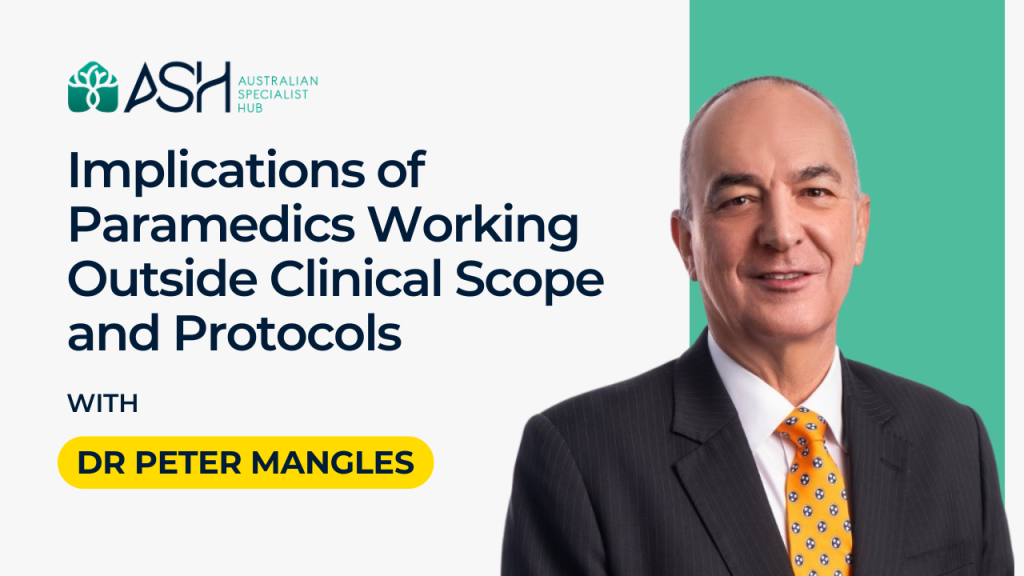
Medico-Legal Implications of Paramedics Working Outside Clinical Scope and Protocols – Dr Peter Mangles
Paramedicine is a dynamic and evolving healthcare profession grounded in clearly defined regulatory frameworks, professional standards, and robust systems of clinical governance. Paramedics are highly trained health professionals entrusted with delivering rapid, often life-saving interventions in complex, unpredictable, and high-pressure environments such as roadways, patient’s homes, industrial sites, and remote settings. Their practice is governed by Clinical Practice Guidelines (CPGs) and legislated scopes of practice that ensure patient safety, professional accountability, and consistency in care.
Given the autonomous nature of paramedic decision-making, particularly in out of hospital settings where direct supervision is limited or absent, strict adherence to scope and protocols is essential. Deviation from these guidelines, whether intentional, due to a lack of understanding, or in response to situational pressures, can lead to serious clinical errors. These may result in harm to patients, erosion of public trust, and significant medico-legal ramifications for the practitioner and employing organisation alike.
In Australia, the legal and professional expectations placed upon paramedics are reinforced by national registration through the Australian Health Practitioner Regulation Agency (AHPRA), with failure to comply potentially resulting in disciplinary action, deregistration, or litigation. Understanding these boundaries is not only a matter of legal compliance but also a fundamental ethical obligation. This article critically examines the medico-legal risks associated with paramedics working outside their approved scope or deviating from CPGs. It presents a real-world case study that illustrates the impact of such decisions, discusses the potential consequences for both patient outcomes and practitioner liability, and highlights the essential legal and professional responsibilities paramedics must uphold within the Australian healthcare system.

Understanding Scope of Practice and Protocols
Prehospital Emergency Medical Services (EMS), often referred to as ambulance or paramedic services, is described as a coordinated medical response system encompassing all stages of emergency care, from the initial recognition of a medical crisis and access to healthcare, to dispatching the correct responders, providing pre-arrival guidance, delivering hands-on care by qualified personnel, and ensuring suitable patient transport or referral (Millin, & Hawkins, 2017).
In Australia, the Australian Health Practitioner Regulation Agency (AHPRA) defines a registered paramedic’s scope of practice based on their education, competence, and clinical guidelines issued by their employing service. Most ambulance services, such as NSW Ambulance, Ambulance Victoria,St John WA, South Australia Ambulance Services, Tasmania Ambulance Serviceor theQueensland Ambulance Service, publish specific Clinical Practice Guidelines which standardise care delivery and delineate the bounds of practice for different practitioner levels (e.g., Emergency Medical Technician, Paramedic, Critical Care Paramedic, Intensive Care Paramedic).
The National Health and Medical Research Council (NHMRC) of Australia advocates for the development of high-quality, evidence-based clinical practice guidelines (CPGs) with the aim of “promoting health, preventing harm, encouraging best practice, and reducing waste. To achieve these goals, the NHMRC emphasises that CPGs should be “based on systematic reviews of evidence, transparent development processes and decision-making, and the judgment of evidence by experts, consumers, and other end-users” NHMRC (2024). The Queensland Ambulance Service (QAS, 2024) Clinical Practice Manual (CPM) includes Clinical Practice Guidelines (CPGs), Clinical Practice Procedures (CPPs) and Drug Therapy Protocols (DTPs).
These policies:
- inform and guide clinical decision making by ambulance clinicians
- provide instructions to perform authorised clinical procedures
- provide directions for the administration of authorised pharmacological agents in prescribed circumstances.
Clinical Practice Guidelines (CPGs) serve as foundational instruments in the governance of paramedic practice, providing authoritative direction for the assessment and management of a wide range of clinical presentations. These guidelines represent the accepted standard of care and are routinely referenced in the evaluation of clinical decision-making within the paramedicine profession. Over time, CPGs have evolved in complexity and scope, reflecting the maturation and professionalisation of paramedic practice.
Historically, early ambulance protocols were rudimentary and directive in nature, designed primarily to assist in the instruction, implementation, and oversight of basic medical interventions. Contemporary CPGs, however, function as sophisticated clinical governance tools, guiding practitioners through evidence-based care pathways while ensuring adherence to professional, legal, and ethical obligations
Deviation from these guidelines without explicit authorisation, such as administering Schedule 8 medications without credentialing or performing advanced airway management outside one’s certified training, constitutes “working out of scope”. This behaviour is considered not only a breach of professional standards but potentially unlawful.
Case Study: Adverse Event Following Out-of-Scope Intervention
In a notable case that underscores the medico-legal implications of working outside one’s scope of practice, a paramedic administered intravenous midazolam to a patient actively seizing, despite lacking the necessary credentialing to perform IV drug administration under their jurisdiction’s Clinical Practice Guidelines (CPGs). The paramedic, acting with the intent to prevent further neurological compromise, had not completed the mandated intravenous therapy module nor had they received formal authorisation for IV medication delivery.
The decision, though made in a high-pressure clinical scenario, ultimately led to significant patient harm. Following the administration of midazolam, the patient experienced marked respiratory depression, a known adverse effect of benzodiazepines, necessitating advanced airway management and admission to an intensive care unit for ventilatory support. The delay in recognising the onset of respiratory compromise further compounded the risk to the patient, highlighting gaps not only in clinical scope but also in preparedness for post-intervention complications.
The Health Care Complaints Commission (HCCC) initiated a formal inquiry into the incident. Their investigation concluded that while the paramedic’s motivations were rooted in perceived clinical necessity, the deviation from established protocols and lack of required competencies constituted a clear breach of professional standards and duty of care. This breach met the threshold for clinical negligence, as the paramedic failed to act within the boundaries of their endorsed scope of practice and skill level.
As a result, the paramedic was subjected to disciplinary proceedings, which included a temporary suspension from clinical duties. A structured performance improvement plan was mandated, requiring the completion of the intravenous therapy module, supervised clinical practice, and reflective learning on clinical governance and accountability. The case also prompted an internal service review of credentialing processes, emergency decision-making under duress, and the efficacy of ongoing professional development programs. This incident serves as a cautionary example of how even well-meaning clinical decisions, when misaligned with professional scope, can result in serious patient harm and significant legal consequences.
Medico-Legal Consequences and Duty of Care
Under Australian common law, all registered health practitioners, including paramedics, owe a legally enforceable duty of care to those under their clinical management. This duty is not discretionary; it arises automatically once a clinical relationship is established, irrespective of the urgency or environment in which care is delivered. For paramedics, who frequently operate in uncontrolled and high-pressure settings, this duty intersects directly with professional expectations around adherence to scope of practice and compliance with endorsed Clinical Practice Guidelines (CPGs).
When a paramedic engages in clinical actions that fall outside their authorized scope or disregard established CPGs, regardless of good intent, they may be found to have breached this duty. The consequences of such a breach are multifaceted and can include:
- Civil litigation for negligence, where a patient suffers harm as a direct or proximate result of the paramedic’s deviation from expected standards of care. Courts will examine whether a competent practitioner, acting reasonably, would have followed the same course of action.
- Professional misconduct investigations and disciplinary action under the Health Practitioner Regulation National Law Act, administered by the Australian Health Practitioner Regulation Agency (AHPRA) and the relevant National Board (Paramedicine Board of Australia). Sanctions can include mandatory retraining, conditions on practice, suspension, or even cancellation of registration.
- Loss of employment or contractual privileges, particularly within public ambulance services or private medical transport providers, due to breaches of organisational protocols, risk to reputation, or insurance liabilities.
- Criminal prosecution in cases where conduct is considered grossly negligent or reckless, particularly involving the unauthorized administration of scheduled medications. Charges may range from assault or unlawful administration of poisons to criminal negligence causing harm or death.
Paramedics are uniquely vulnerable to legal scrutiny because of their expanding autonomous practice and the growing complexity of pre-hospital care. Their actions are judged not only by outcomes but also by strict adherence to the regulatory framework governing safe and ethical practice. The transition of paramedicine into a nationally regulated profession under AHPRA has further codified the responsibilities of paramedics, reinforcing that clinical justification alone is insufficient if actions fall outside regulatory or legal boundaries.
The courts, regulators, and professional boards consistently emphasize that “well-intentioned” is not synonymous with “lawful” or “safe.” As such, ongoing education, supervision, and internal audits of clinical compliance are not optional but essential components of professional paramedic practice. These measures safeguard both the public and the practitioners themselves from the significant legal ramifications that can result from working out of scope.
Potential Negative Patient Outcomes in Paramedicine
Paramedics working outside established clinical practice guidelines or their scope of practice may expose patients to significant risk, potentially leading to adverse outcomes. Clinical guidelines, such as those developed by Ambulance Services, exist to promote evidence-based decision-making and mitigate avoidable harm. When these are not adhered to, the consequences can be serious and multifactorial.
- Medication errors leading to toxicity or insufficient treatment:
Errors in pharmacological administration, such as incorrect dosing, route, or medication choice, can result in toxic effects or inadequate symptom management. For example, administering excessive morphine may lead to respiratory depression, while underdosing analgesics in trauma patients can result in poor pain control and heightened physiological stress. According to Vilke, Tornabene, and Stepanski, medication errors in prehospital care are particularly concerning due to the fast-paced and often chaotic environment, making strict adherence to guidelines vital. - Incorrect procedural interventions:
Technical errors, including misplacement of airway devices or excessive fluid resuscitation in trauma cases, may worsen clinical outcomes. Misplaced supraglottic airways or endotracheal tubes, for instance, can lead to hypoxia or aspiration. Inappropriate fluid resuscitation in cases such as traumatic brain injury or uncontrolled haemorrhage may exacerbate intracranial pressure or dilutional coagulopathy, respectively, reinforcing the need for protocol-driven intervention. - Delays in definitive care due to mismanagement:
When paramedics apply interventions beyond scope or delay transport in favour of inappropriate treatment, it can mask the severity of underlying conditions and delay definitive care. emphasized that prolonged on-scene times, particularly in time-critical conditions like myocardial infarction or stroke, are associated with poorer patient outcomes. Misjudged interventions may create a false sense of clinical stability, deferring necessary escalation. - Loss of public trust and reputational damage to the profession:
Beyond clinical risks, deviation from professional standards may erode public confidence in ambulance services. If harm occurs due to unprofessional conduct or negligence, not only are patient rights compromised, but the broader paramedicine profession faces reputational harm.
The practice of paramedicine in Australia is governed by a framework that emphasizes professional responsibility, evidence-based clinical care, and adherence to legislated scope of practice and Clinical Practice Guidelines (CPGs). This article has demonstrated that any deviation from these standards, whether driven by urgency, misjudgement, or lack of credentialing, can have profound medico-legal and clinical consequences. As evidenced by the case study, the administration of treatment beyond one’s authorised scope, even with benevolent intent, can result in significant patient harm, disciplinary action, and legal liability.
Paramedics operate in challenging environments where decisions are made rapidly and often without immediate oversight. It is therefore imperative that their actions remain within defined professional boundaries to ensure the safety of patients, uphold public trust, and mitigate legal risk. Employers and regulatory bodies also share the responsibility of ensuring practitioners are adequately trained, credentialed, and supported through governance structures that reinforce clinical accountability.
In conclusion, working within scope and protocol is not merely a regulatory requirement, it is a cornerstone of lawful, ethical, and safe paramedic practice. As the profession continues to evolve, the imperative for continuous professional development, systems of clinical oversight, and adherence to legally endorsed guidelines will remain central to maintaining high standards of care and professional integrity within Australia’s healthcare landscape.
Author
Dr. Peter Mangles
References
Bergmans, S.F., Schober, P., Schwarte, L.A., Loer, S.A., & Bossers, S.M. Prehospital fluid administration in patients with severe traumatic brain injury: A systematic review and meta-analysis. Injury. 2020 Nov;51(11):2356-2367.
Brown, J. B., Rosengart, M.R., Forsythe, R.M., Reynolds, B.R., Gestring, M.L., Hallinan, W.M., Peitzman, A.B., Billiar, T. R., & Sperry, J.L. (2016). Not all prehospital time is equal: Influence of scene time on mortality. Journal of Trauma and Acute Care Surgery 81(1):p 93-100.
Makrides, T., Ross, L., & Gosling, C. (2022). From stretcher bearer to practitioner: a brief narrative review of the history of the Anglo-American paramedic system. Austral Emerg Care. 2022; 25:347-353
Maria, S. (2021). Paramedics’ clinical reasoning and decision making in using clinical protocols and guidelines Flinders University, Adelaide, Australia, 2021.
Maria, S., Colbeck, M., Wilkinson-Stokes, M., Moon, A., Thomson, M., Ballard, J., Parker, L., Watson, F., & Oswald, J. (2024). Paramedic clinical practice guideline development in Australia and New Zealand: A qualitative descriptive analysis. Australasian Emergency Care, Volume 27, Issue 4, 259 – 267
Millin, M. G, & Hawkins, S.C. (2017). Wilderness emergency medical services systems. Emerg Med Clin North Am. 2017;35(2):377–389.
National Health and Medical Research Council. 2014 Annual Report on Australian Clinical Practice Guidelines. Canberra: National Health and Medical Research Council; 2014
O’Meara, P., Stirling, C., Ruest, M., & Martin, A. (2015). Community paramedicine model of care: an observational, ethnographic case study. BMC Health Services Research, vol. 16, no. 1, 2016, pp. 39–39
Queensland Ambulance (2024). CPM: Clinical Practice Manual, retrieved 4 June 2025 from https://www.ambulance.qld.gov.au/clinical/cpm
Strandås, M., Flores V.M., Ingstad, K., Sepp, J., Linnik, L., Vaismoradi, M. (2024), An Integrative Systematic Review of Promoting Patient Safety Within Prehospital Emergency Medical Services by Paramedics: A Role Theory Perspective an Integrative Systematic Review of Promoting Patient Safety Within Prehospital Emergency Medical Services by Paramedics: A Role Theory Perspective. Journal of Multidisciplinary Healthcare, vol. 17, 2024, pp. 1385–1400.
St John WA Clinical Practice Guidelines. (2021). St John Ambulance Western Australia.
Took, A, (2011). Health Law in Australia – Book Review. Health Information Management Journal, Volume 40, 01/2011.
Vilke, G. M. Tornabene, S. V., & Stepanski, B. (2007). Paramedic Self-Reported Medication Errors. Prehospital Emergency Care, 2007, Volume 11, Issue 1
Ward, J.E. (1996). Why we need guidelines for guidelines: a study of the quality of clinical practice guidelines in Australia. Med J Aust. 1996; 165:574-576